February 2014
UNSKILLED
Highly skilled workers are usually paid more than those who are unskilled. Often associated with this observation is the idea that better training and education will bring higher pay to the unskilled worker after having had the benefit of such schooling and the chance to learn new skills.
That may well be true for a number of those who get more education.
Still jobs requiring only basic or elementary skills will be here even if the vast majority of individuals succeed in getting the level of skills that is demanded for the highest paid positions in our work places.
Since employment requiring few or no high level skills will never go away, what should the level of compensation be for those who work at such jobs?
Let us consider the compensation for a high skilled job:
The position of Chief Executive Officer
at JPMorgan Chase, a large American bank.
Mr. Jamie Dimon holds that position and he is receiving compensation of twenty million dollars for his work there in 2013.
For CEO Dimon that equals $384,615 per week, or $76,923 each day given a five day work week.
So what should an unskilled worker receive - a hundred times less?
Probably not, that would be $769 each day.
Two hundred times less?
Unlikely, that would be $384 each day.
In fact, Federal law only requires that an unskilled worker must be paid no less than $7.25 per hour.
That is $58 per day for eight hours of work.
Mr. Dimon is paid six thousand six hundred and thirty-one times more each day . . .
than a minimum wage worker is paid for one day of employment.
Look at it this way:
===============================
Mr. Dimon earns in one week what a minimum wage worker will earn in twenty-five and a half years.
================================
So how about unskilled workers?
How does one determine what compensation each unskilled worker should receive for his or her work effort?
Perhaps we may agree that each full-time adult worker at any skill level should receive minimum compensation that is enough to pay for the following:
- Housing with a bathroom, a place to cook, and a place to sleep;
- Common utilities - gas, electricity and a telephone;
- Food that satisfies minimum daily nutritional needs;
- Clothing for five days of use without having to wash;
- Public transportation to and from work and markets;
- A five year old used car if public transportation is unavailable;
- Savings for retirement by age seventy;
- Medical and dental care; and,
- Pocket money of two and a half dollars each day.
For a single adult under thirty living in the least expensive local housing, here is a weekly estimate of the income needed for that full-time worker to pay those costs in these different places:
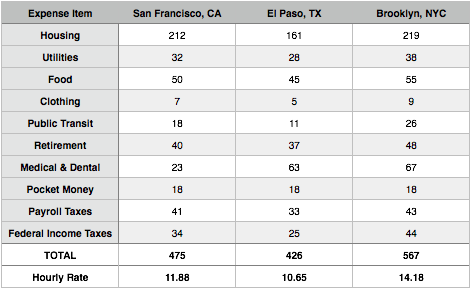
Are these amounts too extravagant to pay to unskilled workers who are employed full-time?
Surely we may imagine this possibility in our country where tens of millions would never dream of leaving home without their smart phone, to drive wherever they please and to buy whatever they want.
Perhaps we should give it a thought. . .
while passing through the various events of our very busy days.